Theoretically, Week 1 of ITU Plenipotentiary Conferences are meant to be dedicated to:
- High level policy statements by government ministers and other high-level representatives during Plenary sessions
- Lots of campaigning by Member States for various ITU elections that take place at the end of the week
These two strands are still very much alive and well in this first week of Plenipot in Doha.
However…
Because Member States also chose to be very busy little bees and submit over 400 proposals to the conference, in practice, the core work of the conference had to begin this week – Tuesday in fact – if there was to be any hope of getting through the very full agenda Member States have created for themselves.
Substantive policy discussions already underway
Plenary has already spun work out into the various committees and the Working Group of Plenary (WG-PL). And in turn, those committees and WG-PL have already begun spawning yet more specific groups to discuss more targeted discussion on resolutions or groups of resolutions related on the same theme. We are already seeing parallel Ad Hoc Groups being scheduled in parallel as of Thursday of Week 1.
Below is my own very unofficial diagram showing how things can become complicated very quickly:
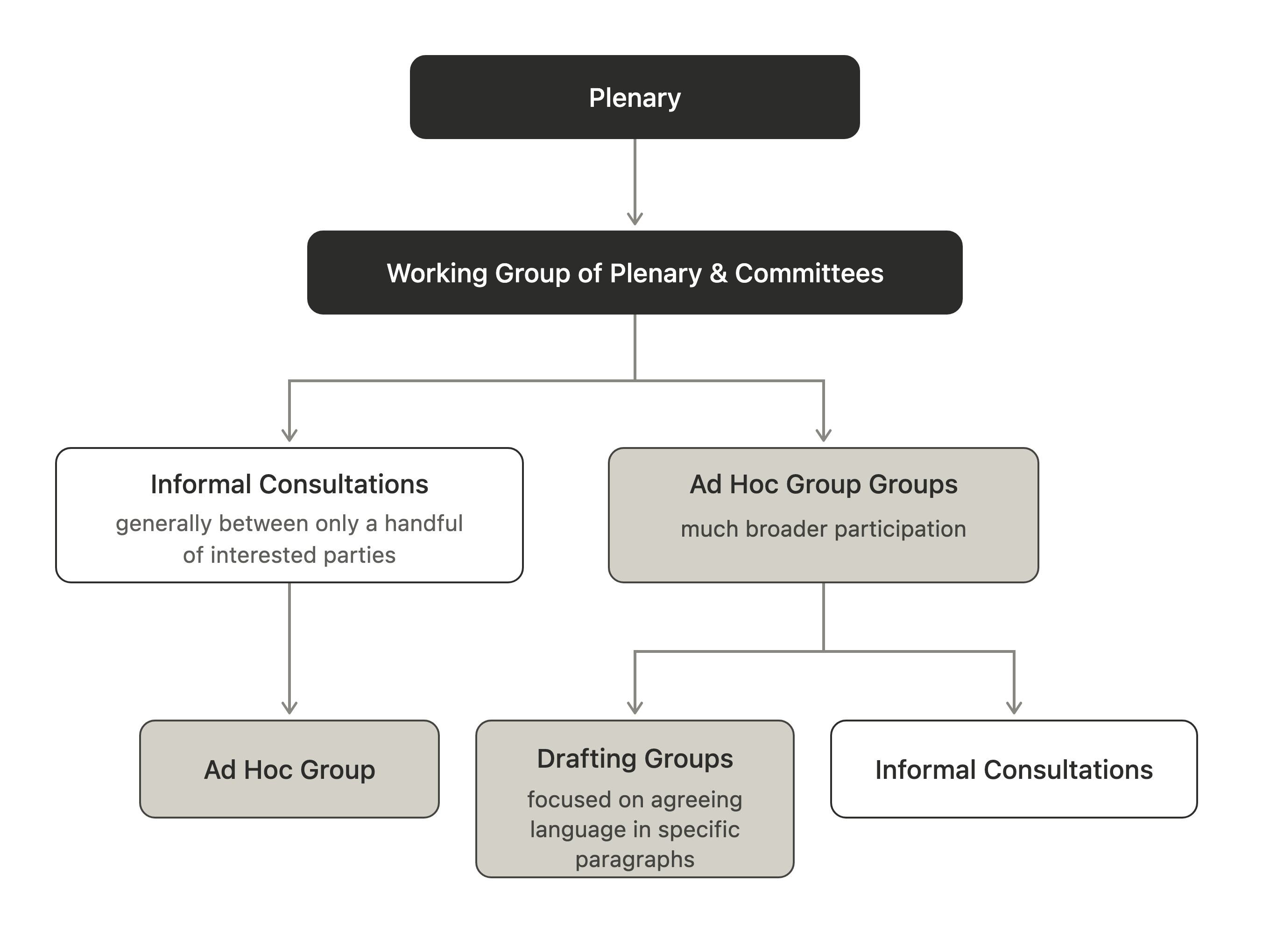 To explain the above diagram:
1. Committees and WG-PL first hear presentations of proposals from Member States.
If by some miracle, there is agreement right then and there on a proposal, it can be adopted by consensus and then referred back to Plenary for adoption by the entire Plenipotentiary Conference.
Usually, however, there needs to be more work as there are multiple views on submitted proposals. In that case, move to step 2:
2. Committees and WG-PL can send discussion for proposals on particular resolutions, or groups of resolutions with a similar theme, to either:
- Informal Consultations
This is usually between two or three parties who have submitted proposals and who might be able to find a mutually agreeable way forward that can then be presented back to WG-PL or a Committee, in the hope of quickly finding consensus on updates to a resolution. The submitted proposals involved in Informal Consultations tend to very targeted, and not major changes proposed across the entire existing resolution. However, if agreement can’t be reached, it may end up needing to become an Ad Hoc Group.
- Ad Hoc Groups
These are the groups that end up taking up most of Week 2, as Member States negotiate proposals that address many areas of a resolution (or resolutions), and where there is often not much consensus in proposals that have been submitted by different regions on the exact same areas of text. WG-PL and the Committees can end up spawning so many Ad Hocs, or AHGs, that there can easily be more than 6 happening in parallel at any one time. Even when the sessions are scheduled to go from 8 am to 10 pm, to try and reduce the number of parallel sessions.
3. Ad Hoc Groups on particularly difficult topics can then create their own sub-processes:
- Informal Consultations
These are like the Informal Consultations that are created in WG-PL and Committees. Ad Hoc Group Chairs can send off interested parties to discuss specific competing proposals that are of immense interest to a handful of Member States, but would chew up valuable time in the main Ad Hoc for the majority of Member States who have no particular position on the proposals spun off to Informal Consultations.
- Drafting Groups
Here, there is general consensus on a topic, but the exact language used to express it has become the sticking point. So the Chair sends of the interested parties to argue it out amongst themselves, then come back to the wider group with an agreed text to present to the whole group.
At this level, the debate is about drafting the text in English, which means those delegates who don’t have a high proficiency in English are very much at a disadvantage, as subtle differences between words that can appear to be completely matching synonyms in English but in fact differ in how they can be interpreted, can very much alter the implementation trajectory of the text being drafted. (This is a problem, even when there is interpretation in the six UN languages, by the way, as there are still a vast number of Member States who don’t speak any of the six languages as their first, or even second language.)
3. Drafting Groups, Informal Consultations and Ad Hoc Groups report back to the process that created them, and so on, up the chain, until a (hopefully) consensus resolution finally ends up back in Plenary for final adoption.
Ad Hoc Groups coming up of interest to Internet and digital technology folks
Note: these times are subject to change, especially given the probable need to hold a third vote for the position of ITU Deputy Secretary-General.
- Ad Hoc Group on Cybersecurity themed resolutions (130, 174, 179 and spoofing).
First meeting 17:30 Doha time, Friday, 13 November. May end up needing to meet on Saturday. To report to WG-PL Monday, 16 November.
- Ad hoc group on AI (Resolution 214).
First meeting 9:30 Saturday, 14 November. To report to WG-PL on Monday, 16 November.
More Ad Hocs are being created for other areas of interest, including International Telecommunication Regulations (ITRs) and the WSIS and Internet-related resolutions, but no details available for those yet.