Overarching IGF 2013 theme: building bridges

igf-2013-logoThe IGF 2013 theme was really an outcome of the first preparatory meeting held in February. It was partly prompted by the Internet governance community’s desire to heal inter-stakeholder group relations after the decision by a number of States to not sign the ITRs at WCIT was spun as an example of yet another “developed versus developing countries” roadblock. It was also the result of the more positive collaborative tone expressed during the UNESCO WSIS+10 review meeting immediately before the February IGF 2013 preparatory meetings.

Following the discussion of Brazil’s draft “Opinion 7” at the WTPF only the week before the May IGF preparatory meetings, there was continued support amongst MAG members to uphold the “building bridges” theme. The theme agreed to in full is:

Building bridges: Enhancing multistakeholder collaboration for growth and sustainable development


IGF 2013 themes: critical Internet resources out, human rights and freedom of expression in

The open consultations day began with China’s representative on the MAG reading out a multi-page document already available to all on the IGF website. In short, the submission strongly stated that it was necessary to maintain management of critical Internet resources as a sub-theme for IGF and that inclusion of human rights/freedom of expression in the main themes for IGF 2013 was inappropriate. China maintained that stance throughout the preparatory meetings, resulting in others at the meeting working hard to address China’s concerns:

  1. On freedom of expression
    • It was pointed out that there had been over 30 workshop proposals submitted on the theme of human rights, so it would be remiss of the IGF not to give human rights topics the attention the Internet governance community wished such topics to have.
    • It was noted that the CSTD WG on IGF Improvements had recommended that IGF be more responsive to evolving priorities emerging from international debates.
    • Similarly, it was noted that the UN Secretary General’s report renewing the IGF’s mandate had referred to the fact that the IGF hadn’t given enough attention to human rights issues.
  2. On critical Internet resources (CIR)
    • It was noted that while the topic wasn’t on the list of IGF sub-themes, it was included as one of the workshop main tracks, so it was certainly not being dropped as one of the overall themes of IGF.
    • It was noted IGF was attempting “evolution, not revolution” and that older issues like CIR were still there, but that the discussions have advanced, and older issues are being framed in more nuanced ways.

The representative of China on the MAG clearly had a very strict mandate from his superiors to get CIR on the agenda and human rights off the agenda, because he was utterly tenacious in arguing his case right until the last moments of the MAG meeting. However, nobody else in the room supported his position.

In the end, with time slipping away, Markus Kummer, interim Chair, proposed that because of the need to let the UN Undersecretary General know what the IGF 2013 themes would be (to begin the formal process of issuing stakeholder invitations to the event), he would submit a report stating that there consensus from all but one MAG member to the proposed main theme and sub-themes. The Chinese representative asked if his alternative proposal for IGF 2013 main themes be included in the report. Kummer agreed that was certainly possible and that he would talk to the Chinese representative after the MAG meeting to follow up with this.

Summary of main themes to be addressed in IGF 2013 main sessions

Below are the themes that Kummer will send to the Undersecretary General. I’ve divided the consensus-minus-one themes for IGF 2013 into two groups, to make it easier to see what’s old and new. Please note that the final report from the meeting hasn’t been published yet, so I’ve based it on the wording from the transcripts and from a post by Izumi Aizu to the Civil Society Internet Governance Caucus mailing list.

  1. Evolutions of older IGF themes (old theme names in italics):
    • Access and diversity: Internet as an engine for growth and sustainable development
    • Openness: Human rights, freedom of expression, and the free flow of information on the Internet
    • Security: Legal and other frameworks: spam, hacking, cybercrime
  2. New themes prompted by their recent rise to prominence in multiple venues:
    • Internet governance principles
    • Principles of multistakeholder cooperation
    • Enhanced multistakeholder cooperation

Next up: IGF 2013 program
IGF open consultations in May

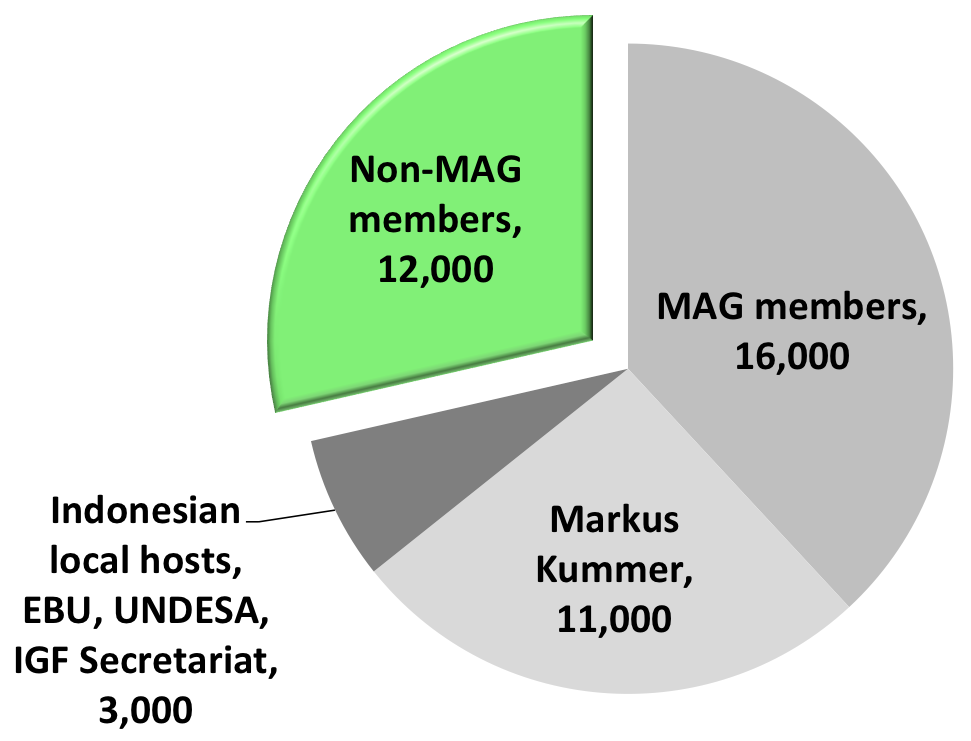
The IGF may need to reconsider the open consultations format if this May’s open consultation was any indication. I used the transcripts (and here) to perform a rough analysis of who spoke on the day and this is the outcome (rounded down to the nearest thousand words):

open-consultation-pie-chart

Who said what during May 2013 IGF open consultations

    Notes on the pie chart:

    • Markus Kummer’s words have been split from the others because of his role as interim Chair.
    • Likewise, I grouped together the word count from the informational presentations by the Indonesian local hosts, the official welcoming speeches by EBU and UNDESA and the comments by Chengetai Masango in his IGF Secretariat administrative role.

If you add up the total number of words said by Kummer, MAG members, and the miscellaneous others, that’s a whopping 30,000 words compared to only 12,000 words from non-MAG members.

Even if you remove the miscellaneous others, it’s still 27,000 words from MAG members and the Chair to a mere 12,000 from non-MAG participants (including remote interventions).

Another way of viewing it: of the 42,000 words spoken at the May open consultations, only 12,000 were spoken by the general Internet governance community.

Is the answer as simple as reminding MAG members that the open consultation day is for them to gather feedback from the community? Or is the problem more complex than overly talkative MAG members? Is the problem related to the Internet governance community itself?

Non-MAG members who spoke on the day

The majority of non-MAG member contributions came from a handful of well-known faces: Marilyn Cade, Milton Mueller, Zahid Jamil (ex-MAG), Martin Boyle and Avri Doria. All of these people have been prominent members of the Internet governance world for the last decade or more. I am not in any way criticizing their contributions. All have strong opinions on Internet governance issues and it is good that they contributed their views. They also represent different perspectives from within the business, technical and civil society stakeholder groups, which is important to the multistakeholder IGF.

But where was the wider community? The newer voices? The voices that the IGF is supposed to be encouraging to participate in the wider Internet governance ecosystem?

Why are so few newer voices participating in the preparations?

Contributing to open consultations isn’t limited to those who can afford the trip to Geneva. Remote participation is available to all. However, only around 30 people in total logged into the remote participation room on the open consultation day. One of the problems could have been the decision to schedule the preparatory meeting at the same time as the Stockholm Internet Forum. The Stockholm Internet Forum attracted a lot of the Internet governance crowd who may normally be interested in IGF open consultations. But the open consultations began a day before the Stockholm Internet Forum started, meaning that those who had arrived in Stockholm could have participated remotely.

Is it enough that newer voices participate in the annual global IGF? Is it okay that they don’t participate in the preparatory processes?

Given the fact that, during the MAG meeting that followed the open consultations, MAG members repeatedly commented that proposed workshops submitted by newcomers were consistently lower in quality than those submitted by the usual crowd, we may be seeing a negative feedback loop in action…

It’s difficult for newcomers, particularly from developing countries, to attend IGF without a specific purpose (being a speaker or session organizer). In turn, it’s hard for newcomers to know from experience what makes a good workshop, leading to their workshop proposals being rejected. And by not having workshops accepted, they yet again can’t justify attending IGF, leading newcomers to perhaps not feel they have enough experience to contribute meaningfully to IGF preparatory processes.

The developing country participants on the MAG certainly expressed a need for IGF to address the difficulties faced by developing country stakeholders during the May meeting. As a result, the MAG had agreed to work with the lower-scored workshop proposals from newcomers in an attempt to include more newcomers in the organizing of IGF activities.

With any luck, this may encourage more newcomers to participate in next year’s IGF preparatory process.

What is the future of the IGF open consultation day?

Another view is that the preparatory processes is just not important enough for most of the Internet community to set aside time to participate in. Let’s face it. The Internet governance calendar is already splitting at the seams with worthy events.

In which case, is it important that IGF continue following the open and participative process of holding open consultations, even if most of the wider community chooses not to participate? Is maintaining the principle of seeking multistakeholder input into a multistakeholder event more important than the reality: a lack of significant and diverse input by the community?

Given the MAG members made the overwhelming majority of contributions at this May open consultation meeting, perhaps it might be making the first day of the three-day preparatory meeting more flexible. For example, perhaps the Chair could ask MAG members to refrain from commenting during the open consultations-except to answer questions from non-MAG participants-and if all non-MAG members have exhausted their contributions by lunch or early afternoon, the MAG meeting could begin earlier.

There are lots of other ways IGF could encourage more participation on open consultation days, including:

  • Don’t hold the open consultations in the same week as another major Internet governance event
  • Limit the number of interventions any one person can make
  • Actively ask the quiet people who are in the room (or in the remote participation room), but haven’t requested the floor, for their opinions on specific issues under discussion
  • In advance of the meeting, publish specific questions for the community to consider rather than a general call for contributions
  • Have MAG members reach out to people in their professional spheres to encourage them to participate remotely, if only for an hour or two
  • Have MAG members conduct outreach when attending other Internet governance-related events, collecting feedback from the community on the fly, and report back during open consultation days on what they’ve been told by members of the community

Oh, and don’t let anyone who’s submitted a multi-page written contribution, particularly if they’re a MAG member, read out their contribution in its entirety at the beginning of the open consultation. It’s a mood killer, for sure.


The final day of WTPF-13

First of all, I apologize, dear reader, for taking so long to post this. I started writing a week ago then got sidetracked into analyzing the earlier versions of the Brazilian draft proposal. It all became so complex, that I’m now splitting it all up into a series of posts over the next few days.

To begin with, I’ve posted the remainder of my summaries on the three days of WTPF-13:

Also, some short thoughts on what WTPF-13 may mean for the future of inter-stakeholder interactions in the ITU environment:

I’ve previously blogged about the first day and a half of WTPF-13 here. And about the second half of the second day here.

Looking back at WTPF-13: was it a game-changer?

In many ways, what happened at WTPF-13 reminds me of the first IGF in Athens in 2006. In 2006, the Tunis Agenda was only a year old, and had been crafted as a compromise after a lot of heated debate between States during WSIS Phase 2. Those attending the first IGF were wary about the event and whether it could achieve its stated goals.

Similarly, WTPF was the first big ITU meeting after the World Conference on International Telecommunications (WCIT) in December 2012, where a lot of heated debate led to many States not signing the final International Telecommunication Regulations (ITRs).

At both the first IGF in 2006 and this WTPF in 2013, participants began the meetings not really sure whether disagreements from the previous big event would spill over into the current event and prove equally divisive. As it turned out, in both cases, they didn’t.

IGF has moved on from that first slightly wobbly event in Athens to become an important forum in every stakeholder group’s Internet governance calendar. It continues to experiment with formats with the aim of further enabling more open, dynamic and productive discussions on Internet issues. Its openness and flexibility encourages similar traits in those who attend it, which has positive ramifications for multistakeholder engagement on Internet issues outside the IGF.

Will WTPF-13, which the majority of delegates believe was a success, change the way ITU operates in future? WCIT certainly began the process of change for ITU, with its publicly available webcasts. WTPF-13, however, really pushed the boundaries with its preparatory process open to all interested participants. In the past, issues of government’s role in Internet governance has been a highly charged issue where agreement on even high level concepts has been almost impossible to achieve. WTPF-13, with its mix of stakeholder groups, did discuss this highly contentious issue, and didn’t result in further entrenching people’s positions. Instead, there was recognition of the validity of all views.

There was also recognition of the value of including experts who may not be ITU members, but who could offer practical insights into issues being debated at a policy level. This is a major change from earlier ITU meetings where there has often been a gap between the political debates about Internet technologies and the practical realities of how those technologies actually function. The fact that there was no strict order in which WTPF-13 delegates could speak (no “Member States speak first” approach) was also a major change for a large ITU event.

Just as that first IGF in Athens was the start of a new era in multistakeholder Internet governance, I believe WTPF-13 is a big, positive step towards more constructive interaction in the ITU between ITU Member States-even the ones who traditionally haven’t embraced multistakeholderism-and other stakeholders. May ITU long embrace the multistakeholder WTPF model!