ITU Council 2014 – Day 1

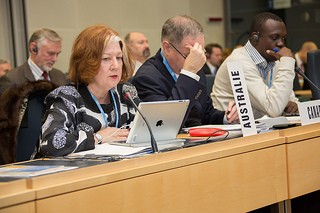
Note: I am attending the ITU Council 2014 meeting as a member of the Australian delegation; however, any of the views I express in this blog post are entirely my own. This post does not reflect the official Australian position, nor is its content endorsed in any way by the Australian government.
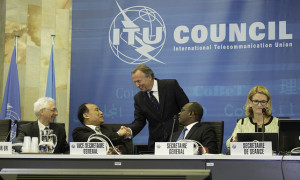
Photo credit: ITU pictures via Flickr

Photo credit: ITU pictures via Flickr

Quick facts and stats

  • Over 500 people registered to attend Council 2014, but the main room only accommodates 260, so the overflow is being sent to Room C.
  • This being the year of the Plenipotentiary Conference, with its many elections for various positions within the ITU, five government ministers—from Australia, Cameroon, Egypt, Ghana and Mali— are gracing the ITU Council 2014 with their presence.
  • The Council continued the tradition of electing the previous year’s Vice-Chair[1] to the position of this year’s Chair position. Mr Aboubakar Zourmba of Cameroon, therefore, is the Chair of ITU Council 2014.
  • Following the tradition of ensuring geographic diversity, it is the turn of Region E (Asia and Australasia) to hold the position of Vice-Chair. Secretary General Toure will report back soon on which member of the Asia Pacific region will hold the position.
  • Australia’s Caroline Greenway was re-elected as Chair of the Standing Committee on Administration and Management (excuse me while I’m parochial for a minute… Aussie, Aussie, Aussie! Oi! Oi! Oi!) Marcin Krasuski (Poland) and Vernita Harris (USA) will also continue their roles as Vice-Chairs in 2014.
  • The Council session has received 26 contributions by Member States. 17 of these were submitted by the deadline (22 April, which is two weeks before the meeting starts). You can find who submitted what and when at the Contributions index page).
  • Freely available versions of all Council 2014 documents have been made available on the WCITLeaks website.

Some of key quotes from Day 1

“There is no beginning and there is no end. There is only change.”—Chair of ITU Council 2013, Catalin Marinescu (Romania)

“One of the Secretaries General of the Union, Mr Mohamed Ezzedine Mili, described the Internet as an explosive marriage between the computer and telecommunications. If we are not careful, those of our people who have difficulty reading and writing may be left by the wayside.”—Chair of ITU Council 2014, Aboubakar Zourmba (Cameroon)

“The Dubai Declaration recently adopted at the WTDC-14 describes telecommunications and ICT infrastructure, services and applications as powerful tools for economic growth and innovation. This is true of course, and yet, infrastructure, services and applications will not foster innovation and from that, economic growth, if innovation is hampered in other ways. Governments cannot legislate innovation, but what we can and should do is make it much easier for businesses in our countries to innovate.”—Australia’s Minister for Communications, Malcolm Turnbull
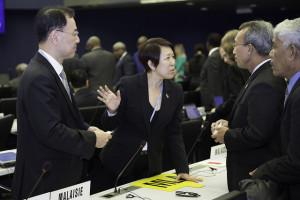
ITU Council 2014

Photo credit: ITU pictures via Flickr

Summary of the most interesting topics (to me) on Day 1

1. Report on the implementation of the strategic plan for 2012-2015 and activities of the Union for 2010-2014

ITU must have one of the best PR and marketing departments of any organization I’ve ever come across. Instead of making participants of ITU Council 2014 sit through a really long read-through of the summarizing this 82-page report, the media folks at ITU put together a slick and glitzy video highlighting ITU’s major achievements over the past few years. The technical bodies of the Internet governance world could certainly learn a thing or two from ITU about producing videos that highlight key achievements in such easily digestible forms. (In contrast, take a look at how the Internet governance world fails to effectively communicate what it’s doing, and manages to confuse many of its own true believers here.)

2. ICTs and people with disabilities

This really is low hanging fruit issue that is impossible for anyone to object to. Like the whole “think of the children”/child online protection issue, anyone who objects to activities that help a group of people with intellectual or physical disabilities really is entering Cruella De Vil territory. Of interest, though, was a suggestion by a Member State to use the term “disabilities and specific needs” in all future ITU documents on this issue (this term made its first appearance in the ITU context in the documents of the recent WTDC-14 held in Dubai).

3. Gender mainstreaming and promotion of gender equality and the empowerment of women through ICTs

After the protracted debate on the equal participation of women in Internet governance at last week’s CSTD WGEC (I’m still to blog on this… watch this space), it was a relief to hear overwhelming support by the Council members for the need to encourage equal participation of women in the ITU sphere. It was less encouraging that of the seven interventions from the floor supporting the ITU’s work in this area, six of the interventions were made by men.

The ITU Secretariat provided some historical data on women’s participation in ITU (and its previous incarnations). The first woman to take the floor was from the Soviet Union during a 1932 meeting (that’s 67 years after the creation of International Telegraph Union). And the first woman to be a head of delegation was from Bolivia, in 1962 (97 years after the creation of the Union). These statistics aren’t published on the ITU website yet, but the staff responsible for implementing Plenipotentiary Resolution 70 (Rev. Guadalajara, 2010) are compiling more information about the history of women’s participation in ITU and the result of that work will hopefully be published on the ITU website in some form soon.

A written statement by ITU Secretary General Touré, read out by Deputy Secretary-General Houlin Zhou, noted that the implementation of gender mainstreaming was a high priority for ITU in 2014. As part of its gender mainstreaming activities, ITU will be launching the GEM (Gender Equality and Mainstreaming) awards at a side event on gender issues during ITU Plenipotentiary Conference 2014 (PP-14).
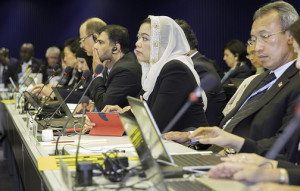
ITU Council 2014

Photo credit: ITU pictures via Flickr

4. Free access to ITU publications

While ITU has expanded the number of publications available for free, in 2013, its revenues from the sale of publications increased when compared to the previous year’s sales. Interestingly, CDs and DVDs have experiences the largest growth in sales since 2009, with the overall sales of paper-based publications dropping dramatically between 2010 and 2012. Paper-based publications doubled in sales between 2012 and 2013 however (13% to 26% of sales). Sale of online publications (downloadable formats such as PDFs) has remained extremely small (only 1% of publication sales in 2013). These figures are important because ITU is considering how many other publications to make freely available and how much free availability of documents will affect ITU’s income stream. There were some concerns expressed in the room that additional free documents could have a negative impact on ITU’s budget (ITU is already trying to work out how to do an expanding list of things its members want it to do while also juggling budget constraints). Based on the discussions on Day 1, a draft proposal to make additional documents available freely will be amended by the author State and another interest State.

5. Council Working Group report on WSIS activities

There were two documents submitted by the CWG: C38, which was an overall report on WSIS activities by the ITU, and an Addendum to C38 (which was a report on the CWG’s meeting held on Monday, 5 May 2014). There was a bit of discussion over the way that the Council would take action on the two documents: it was proposed that C38 be “noted” while C38 Addendum 1 be “approved”. Some Member States were reluctant to “approve” the Addendum, given it was a mix of summary paragraphs on the Monday meeting as well as proposals on the way forward. But when the Chair pushed for closure on the topic, asking if anyone had strong objections to the document, Member States kept silent, so the document was approved.

6. Defining “ICT”

The long Council discussion on the definition of “ICT” cheered me up immensely. It put the ongoing debates about what “enhanced cooperation” is, and the never-finalized-but-still-a-working-definition-after-10-years “Internet governance” into perspective. The definition was part of a report by the Correspondence Group on the Elaboration of a Working Definition of the Term “ICT”. The working definition included in the report is:

Technologies and equipment that handle (e.g., access, create, collect, store, transmit, receive, disseminate) information and communication.

The report of the Correspondence Group is meant to be forwarded to the PP-14 for their consideration, but a number of Council members objected to the definition being included in the report as they felt that the definition was not yet “mature” enough. The Chair intervened with “We’ve been discussing this since 2006 and still don’t have a definition of ICT.” Other Member States said that that since the Correspondence Group had been tasked with coming up with a definition by the last Plenipotentiary Conference (in 2010), it was important to report back to PP-14 on the status of its work, even if the current definition wasn’t the final one. A couple of States supported the idea of submitting the report of the Correspondence Group along with a summary of the discussion about the definition of ICTs held here in Council.

After about half an hour of this to-ing and fro-ing, the Secretary General intervened: “This is a chess game. It’s starting again.” At the heart of the definition of ICTs, he said, was the fact that the Internet was lurking in the background. “ICT does include the Internet. Let’s face it. […] This is a very innocent definition […] But it’s not going to fly […] It’s harmless. Whether we define it or not, we’ll continue to work. We’ve been working for 150 years and will continue to work for another 150 years.”

The day ended with the Chair proposing that a small group get together and work on the definition outside of plenary in the hope of finding a consensus solution.

More to come…

Key issues of interest to Internet governance folk:

  • The Council Working Group on international Internet-related public policy issues (CWG-Internet) (Thursday 8 May)
  • ITU’s Internet activities (Thursday 8 May)
  • Opening ITU documents to the general public (Friday 9 May)

[1] Official ITU language only recognizes the terms “Chairman” and “Vice-Chairman”. However, I am not similarly constrained to use such gender-biased terms, and will only use “Chair” and “Vice-Chair”… even if the positions are still overwhelmingly filled by men.
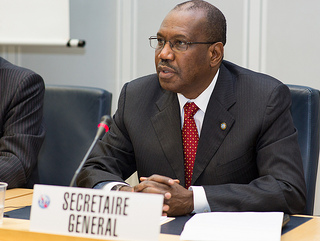
A summary of a very quiet 4th CWG-Internet meeting

Note: I attended the fourth CWG-Internet meeting as a member of the Australian delegation; however, any of the views I express in this blog post are entirely my own. This post does not reflect the official Australian position, nor is its content endorsed in any way by the Australian government.

This is the second part of a two-part report of the fourth CWG-Internet meeting, held 3-4 March 2014. The first part can be found here.

Touré’s opening speech

Photo credit: ITU pictures via Flickr

Photo credit: ITU pictures via Flickr

ITU Secretary General Touré was present at the start of the meeting. His presence sent a signal that this was going to be an important meeting, which of course, we found out to not be the case, but it nevertheless sent a message that this CWG was important to the ITU.

Touré stated that the CWG-Internet was a very important component of the multistakeholder dialogue on Internet issues. He also noted that although Brazil’s draft opinion at WTPF-13 hadn’t reached consensus, it had begun a very important dialogue on the role of governments in Internet governance. He also referred to the responses by 37 Member States to the CWG-Internet’s questionnaire on the role of governments, saying not only would they inform discussions at the CWG-Internet, but would form an important repository of information for future dialogue on the issues they contained. He also noted the series of “Open Talks” he had conducted on Internet-related public policy issues.

Importantly, Touré stated that ITU is part of an ecosystem of organizations dealing with Internet-related matters, and that the ITU works to add value where it can.

37 really interesting submissions to the questionnaire on what governments are doing in terms of Internet-related public policy issues

There were 37 responses to the following question:

  • “What actions have been undertaken or to be undertaken by governments in relations to each of the international Internet-related public policy issues identified in Annex 1 to Resolution 1305 (adopted by Council 2009 at the seventh Plenary Meeting)?“

I don’t think there have ever been as many as 37 Member States present at a CWG-Internet meeting, so to have 37 of the 193 ITU Member States submit a response is a major achievement. There were submissions from both developed as well as developing countries, with good geographical diversity, too. A brief overview of the contents of the responses and the discussion in the room during the CWG-Internet meeting:

  • It was encouraging to see some of the Member States compiled their responses by first conducting consultations with various Internet-related stakeholders within their national borders.
  • A number of Member States reported having various forms of stakeholder consultation processes or advisory groups in place where government departments could solicit opinions and feedback on Internet-related public policy issues under consideration. This helped governments create more effective national policy related to the Internet.
  • A number of governments with such consultation processes noted that although the government ultimately made the decisions about national Internet-related public policy, being able to discuss issues with interested stakeholders gave all parties a better understanding of everyone’s positions and the reasons behind decisions, even if non-government stakeholders held views contrary to those that informed the final decisions.
  • More than one Member State referred to the need for governments to develop public policy in coordination with other stakeholders to ensure that innovation on the Net remained unhindered.
  • Member States agreed that the responses should be placed in a permanent online repository where each Member State could update its submission as circumstances changed.

The CWG-Internet decided that the responses to that questionnaire were, like all CWG-Internet documents, limited to Member States only.[1] A large number of States did very much want the responses to be public, saying that the contents would be very useful for everyone. For a little while, there seemed to be agreement to a proposal that all respondents would be contacted and told that their submissions would be made public on a certain date unless they specifically requested their submission be kept password-protected. This agreement fell apart, however, when one Member State suggested that States who might want to keep their submissions password-protected may feel pressured by other States to make them public. States who did not respond to pressure to publish might then be viewed by the wider public as having something to hide.

The good news, though, is that this CWG-Internet meeting decided that the 37 respondents are free to resubmit their contributions as part of the public consultation process that began on 10 March 2014. All contributions to that public consultation are made public.

Oh, and of course, there’s always WCITLeaks, which has already made all of the responses publically available. I was looking at WCITleaks’ links to the responses while the debate was happening in the room and wondered if I should point out to the pro-password crowd that their battle had been lost before the meeting had even begun. But the debate in the room wasn’t about the reality of whether the documents were available or not. It was about a clash of principles: open versus closed intergovernmental proceedings.

Photo credit: ITU pictures via Flickr

Photo credit: ITU pictures via Flickr

The decision to hold a public consultation

A few Member States had submitted contributions supporting the decision at the third CWG-Internet meeting to hold a public consultation on the role of governments in Internet-related public policy. There had been reluctance back in the third meeting to agree to a public consultation, and States not so keen on a public consultation had successfully introduced an escape clause in the Chair’s report of the third meeting:

  • “The CWG will hold an open multistakeholder consultation on the role of governments immediately after its next meeting in March 2014, based on contributions by Member States.“

While it may not at first be obvious to the casual reader, the “based on the contributions by Member States” text was inserted as a way of allowing the consultation to be quashed if Member States didn’t bother to contribute first (if governments don’t respond on the role of governments, then there would then be no need to hear what non-governments think about the role of governments).

As it happened, with 37 responses by governments, the above argument clearly couldn’t be used to suppress the idea of a public consultation. Instead, creativity was needed. And the arguments of States not wanting to have a public consultation were indeed very creative. One State argued that because many Member States have already stated that they consulted with non-government stakeholders in composing their responses to the questionnaire, the CWG-Internet would learn nothing new by asking non-government stakeholders to submit their responses separately.

A number of Member States were looking forward to holding a public consultation on the same question as that put to governments. But this was another area of contention. Some States argued that it was impossible to use exactly the same question posed to governments as that question was carefully crafted for only governments and nobody else. The strength of this argument was somewhat diminished by the fact that many governments had consulted their non-government stakeholders, and no non-government stakeholders had been harmed as a result of trying to answer this “governments only” question, but anyhow…

Another State argued that there was no way that the same question could be used for non-government stakeholders as there was a risk that non-government stakeholders may contradict the answers governments had submitted as part of the closed governments-only questionnaire. And we can’t have differences in the views expressed by governments and their citizens, can we?

The Member States wanting to ask non-government stakeholders exactly the same question as governments held out for a bit, but eventually capitulated. In the end, to prevent there being discrepancies between what governments have said they’re currently doing in the area of Internet-related public policy and what their citizens say they’re doing, the part of the question about current government activities in the Internet public policy sphere was removed. The final question agreed to was:

  • “What actions are to be undertaken by governments in relations to each of the international Internet-related public policy issues identified in Annex 1 to Resolution 1305 (adopted by Council 2009 at the seventh Plenary Meeting)?“

So, what are the implications of the change of question?

  • It has become a leading question. It suggests that there are things that governments should be doing that they aren’t. It doesn’t give non-government stakeholders a chance to document what governments are already doing. In essence, the question has been successfully reframed by those who believe that governments should have a greater role in Internet governance to produce exactly the sort of result that they want: a set of responses by non-government stakeholders listing areas where governments should be more active. Counterbalancing information, about what governments are already doing, and which may suggest that governments are already doing what’s needed, is excluded.
  • By not including a question about current government activities, there is no way to gather information on government involvement in Internet-related public policy outside the 37 Member States who submitted their responses to the earlier governments-only questionnaire. There are 193 ITU Member States. The CWG-Internet in practice has chosen to actively limit its knowledge about current government practices in Internet public policy to less than 20% of its membership.
  • Given the 37 Member States who responded to the governments-only questionnaire are able to resubmit their responses to this public consultation, we will end up with a collection of divergent responses:
  • One set (from governments) will talk about what they’re doing now as well as what they think should be done in future.
  • A second set (from non-government stakeholders) will only respond to the question about what governments should be doing in future.

How to craft your response to the second CWG-Internet public consultation

The public consultation is open until 26 April 2014.

I suggest that non-government stakeholders making submissions to the public consultation do the following:

  • Note that to contextualize your response to the question about what actions governments should be undertaking in Internet-related issues, it is first important to establish what governments are already doing.
  • Include as many examples as you can about what your national government (or a range of governments, given the public consultation doesn’t limit the question to your own national government) is already doing in relation to Internet-related public policy issues.
  • Include examples of Internet public policy issues where governments are working with other stakeholders. The wider the variety of forms of stakeholder interaction with government are documented, the easier it will be for all stakeholders to learn from the experiences of alternative forms of inter-stakeholder interaction that have not yet been widely documented or publicized. The fact that Member States in the fourth CWG-Internet meeting were asking each other for more details on the forms of multistakeholder interaction they were using is proof that there is genuine interest-even amongst Member States not normally associated with embracing non-government stakeholder interaction-in learning how others develop their Internet-related policy.
  • Encourage stakeholders in the 156 countries who didn’t submit responses to the governments-only questionnaire to submit responses that document current government activities in the Internet governance sphere.
  • Ask your Member State to support your submission at the next CWG-Internet meeting so it doesn’t disappear beneath the waves like the first set of public consultation contributions did at the third CWG-Internet meeting. Your Member State delegate could achieve this by directly referring to your submission in their contribution to the CWG. Alternatively, your Member State could read out the most interesting parts of your submission to the CWG members and provide additional information on the issues discussed in your submission in response to questions by other Member States.

[1] Anyone who followed the 2013 ITU Council debate on the possibility of opening CWG-Internet documents to non-Member States will remember that it was decided that as the creation of the CWG-Internet was a result of a Plenipotentiary resolution, only another Plenipotentiary resolution could make a decision on how open—or otherwise—the CWG should be.

Is CWG-Internet terminally ill or temporarily comatose?

Note: I attended the fourth CWG-Internet meeting as a member of the Australian delegation; however, any of the views I express in this blog post are entirely my own. This post does not reflect the official Australian position, nor is its content endorsed in any way by the Australian government.

Photo credit: ITU pictures via Flickr

Photo credit: ITU pictures via Flickr

The fourth meeting of the ITU Council Working Group on International Internet-related Public Policy Issues (CWG-Internet), held 3-4 March 2014, was a bit of an anticlimax after the very spirited five-day CSTD Working Group on Enhanced Cooperation (WGEC) meeting held the previous week. It seemed that everyone had lost the will to discuss the Internet. Even the Member States keen for a new intergovernmental Internet policy mechanism seemed off their game.

This was the final CWG-Internet meeting before the ITU 2014 Plenipotentiary Conference (PP-14) begins in October. PP-14 will decide the future programs and activities for the Union for the years 2015 to 2018. This includes the future direction of the CWG-Internet. Yet there wasn’t a single contribution to this CWG-Internet meeting proposing how the CWG could or should continue its work after 2014. Of course, the CWG itself can’t decide its work program, but it could have made suggestions on what the group members think is needed and included those suggestions in the CWG-Internet Chair’s report for consideration at the ITU Council meeting in May, and subsequently at PP-14 in October. Instead, the CWG kind of just… floundered…. for its first day, then finished its second day well before noon, having spent the morning finalizing the contents of the 1300 word Chair’s report of the first day.

One of the more colourful Member State representatives—from a Member State that hadn’t submitted any contributions for the meeting—expressed frustration about the lack of progress the CWG seemed to be making. Others also said that there needed to be discussion about the way forward for the CWG. But the fact is that not a single one of these States had taken the time to contribute anything formal to the CWG on possible future directions for the group.

It was all rather odd. Were the frustrated Member States hoping that someone else would do the heavy lifting for them? Was the concerned posturing during the meeting a half-hearted practice run for Internet-related negotiations at the main event, PP-14? Or has CWG-Internet been sidelined by other events and proposals in the Internet governance sphere, including the much-hyped NETmundial in April? Is it simply Internet governance fatigue? Have Member States who’ve been wanting an alternative to the current Internet governance ecosystem, and been forum shopping amongst a growing number of UN bodies, finally reached the same stage of discussion fatigue that those of us who follow the existing Internet ecosystem discussions and the increasing number of UN body discussions have long felt? Are there just far too many big ITU meetings this year and it’s proving difficult to devote time and energy to them all? Frankly, I suspect it’s a bit of all of these things. I guess we have to wait until the next CWG-Internet meeting-if PP-14 resolves to continue the group-to find out whether CWG can wake from its current slumber.

Informal discussions on where the CWG-Internet should go from here

Because there were no formal contributions outlining ways for the CWG to move forward, there couldn’t be any consensus agreements made on the future of the CWG-Internet. But the informal discussions that occurred do perhaps foreshadow more formal proposals for the CWG-Internet’s future activities that may emerge in the lead-up to PP-14. Therefore, I have included a brief summary of those discussions below:

  • One Member State suggested that the CWG-Internet should not duplicate work already being done in other groups.
  • Other Member States suggested that the CWG-Internet should produce more defined outputs (consensus position statements, recommendations, etc.)
  • One of the Member States said that the CWG’s mandate was to focus on international policy (not national Internet policy, which had been the focus of the questionnaire to governments), and the CWG needed to focus on how to address the gaps and weaknesses in international Internet-related public policy so Internet growth could be encouraged.
  • One Member State stated that the CWG-Internet had done its open consultations and it was now time to move on and begin its development phase. The Chair echoed this, stating that open consultation with stakeholders would be an important part of the CWG’s work, but that the group needed to be able to produce structured outcomes from which others can benefit.
  • Another Member State noted that CWG-Internet wasn’t the only group discussing Internet-related public policy issues, but that there is currently no formal relationship that defines how all these groups interact and work on similar or complementary issues. The Member State hadn’t formulated a solution to this lack of clarity but believed something needed to be done if the CWG-Internet was to achieve its objectives.
  • One Member State suggested that the CWG-Internet should beginning looking at the role of governments and the role of other stakeholders in Internet governance. (I should note that I am alarmed by the possibility of a group of governmental folk in a closed environment discussing the roles of non-government stakeholders… and possibly assigning those stakeholders roles in their absence, much like a rerun of the Tunis Agenda definition of stakeholder roles).
  • The Chair wrapped up these discussions by encouraging Member States to submit proposals on the way forward for CWG-Internet to both the ITU 2014 Council and PP-14.

Finally, some musings on the meeting’s participants

There were very few representatives from the Member States that would very much benefit from experience sharing with other States on how to help support Internet development within their borders. In particular, there were only one or two Member States from the African region, and apart from India, none of the developing States from the Asia Pacific region. Latin American and the Caribbean was also poorly represented (Paraguay was present). Instead, the meeting was limited to active participation by Saudi Arabia and Bahrain from the Middle East, Japan, India, Iran and Australia from the Asia Pacific, the USA and Canada from North America and Sweden, UK, Russia, Germany, Poland and Bulgaria from Europe. In other words, the usual suspects, with the usual positions, said the usual things to each other in yet another venue discussing Internet issues.

Is the lack of participation by others a sign of the lack of relevance of the CWG-Internet to their real world needs? Or is the lack of participation a sign of resource constraints preventing developing countries from attending the meeting? ITU does provide fellowships for developing countries, so if non-Geneva based delegates wished to attend, there were some funds available to cover travel costs. This, of course, doesn’t address the issue of limited human resource capacities, and some Member States simply can’t afford to lose a valuable member of their department while they spend a couple of weeks sitting in meetings in Geneva unless they’re certain something of value will come of it. I suspect that lack of relevance played a big part in the lack of participation at this meeting, as the CWG-Internet took place in the same room as earlier CWG meetings, and there were around twice the number of country flags in the room as there were countries represented at the CWG-Internet. Clearly, a lot of the countries felt there wasn’t any need to stay on for the CWG-Internet discussions.

It was also clear that a number of people in the room had very little real understanding of the Internet and ICTs. Many of the same people who attend CWG-Internet meetings are the exact same people who’ve been attending ITU meetings since before the days of the Internet. They’re radio folk, satellite folk, telephone folk, or diplomats from missions in Geneva with a wide portfolio of issues to cover, of which the Internet is just one of many competing for their attention. I understand the need to have experienced diplomats and veterans of the ITU discussing Internet-related issues in intergovernmental spheres, but I also think it would help discussions substantially if those diplomats could bring with them an advisor who understands Internet issues at a level deeper than “I can use the Google”.

My next post, A summary of a very quiet 4th CWG-Internet meeting, reports on the rest of the fourth CWG-Internet meeting, including a summary of ITU Secretary-General Touré’s opening speech, discussion on the 37 contributions to the CWG-Internet questionnaire to governments, and wrangling over the second CWG-Internet public consultation.

Internet governance in 2014: Let’s keep calm and carry on – Part 1

keep-calm-and-carry-onWe spent the last quarter of 2013 developing all sorts if new activities to “fix” Internet governance, managing to thoroughly confuse ourselves in the process. A large percentage of these activities only have relatively short lives and will compete with each other for the attention (and participation) of the wider Internet governance community. In a series of posts over the next few days, I’ll look at those initiatives to see whether all the attention/panic/hand-wringing they’ve generated is warranted and see if there are better ways to approach each of the initiatives.

I’ll start with the big one, the Brazil meeting, which now has the formal name of…

Global Multistakeholder Meeting on Internet Governance (GMMIG)

What we know so far

There are only four months between now and the meeting in Brazil. It’s been just over two months since the meeting was first announced and a month since CGI.br announced that there would be four committees to organize the meeting. We’ve been told that the deadline for proposals to be discussed at the meeting is 1 March, three months from now. Since the 26 November announcement from CGI.br, however, there’s been silence.

No doubt, there is lots of work going on in the background, but there has yet to be a call for nominations for the two multistakeholder committees. Experience in other Internet governance activities has taught us that it will be at least a fortnight between a first call for nominations and a final deadline for nominations (with prerequisite grumbling from stakeholder groups that they don’t have enough time to do proper consultation to identify and select the best candidates). Given we’re heading into the Christmas/New Year silly season, the earliest we’re likely to hear a call for nominations is early January. That gives the committees one and a bit months to get their act together, decide an agenda for the meeting and decide how to handle Internet governance proposals submitted to the meeting.

GMMIG will be a two-day meeting, meaning there will be very little time for real discussion and negotiation between divergent views onsite.

The meeting does not yet have a website. And there have not yet been any official calls to submit proposals for the meeting.

We’ve heard that the local hosts don’t want a cast of thousands at the meeting, but instead will limit the number of representatives from each country and each stakeholder group. (Limiting the number of representatives from stakeholder groups is not a new idea. The oft-praised Brazilian Internet Steering Committee itself has set numbers for each stakeholder group, as has the CSTD Working Group on Enhanced Cooperation.)

What does this mean for GMMIG’s impact on Internet governance?

Let’s look at the meeting that many people have compared it to: the IGF. It takes a year for the IGF to organize each of its meetings. There are no binding decisions, recommendations or statements that come out of IGF, but MAG members and the community still manage to spend a lot of time discussing, disagreeing and developing a compromise IGF program that mostly reflects people’s various interests. (“Everyone is equally unhappy”, as Markus Kummer would say.)

Is the Brazil meeting, with its incredibly truncated preparation period, going to be able to achieve an agenda that not only reflects divergent views on what is important to discuss, but can also achieve the local host’s aim of “pursu[ing] consensus about universally accepted governance principles and to improve their institutional framework” in relation to Internet governance?

How are potential participants going to have the time to read and fully digest what could be a substantial number of proposals in March and early April, which is a period full of existing meetings and processes in the Internet governance sphere (ITU’s CWG-Internet, finalization of CSTD WGEC report, ICANN49, the additional ITU MPP meeting for the WSIS+10 High Level Event)?

If the meeting does result in a consensus on “universally accepted governance principles and [how] to improve their institutional framework”, how legitimate is that consensus, given the limits placed on the number of people who can attend? Do we end up with another optional opt-in set of principles, like the OECD Principles for Internet Policy-Making?

I suspect that with only two days, the best that the meeting can hope for is a very high level, generic set of principles. They may be useful to the extent that the pro-multistakeholder Internet crowd have a statement from a very big government-hosted event to back up their beliefs in bottom-up, participatory Internet governance. But if we look at the OECD principles, have we seen anyone amend their policy-making processes, or stamp their existing policy-making processes as “OECD compliant”?

The meeting is outside the UN framework, so will not have the same level of gravitas that, say, a statement from the 2015 WSIS+10 review can have. The Brazil meeting also does not have a clearly identified and committed community that will go away after the meeting and implement the governance principles, in the same way that IETFers will implement specifications documented in an RFC.

If GMMIG’s outputs are likely to be limited, should we invest our time in it?

Yes, but I’d suggest that we start to view it as a long-term process and not a hectic process lasting only a few months in early 2014.

What I believe is important about GMMIG is that it will probably begin a long-term series of government-hosted meetings that support the multistakeholder principle and look for ways to improve it. OECD and the European Commission have held some interesting meetings related to Internet governance issues, but the fact that most of the countries involved in those meetings have been from developed, not developing, countries, has limited how well the outcomes and recommendations from those meetings are perceived in the developing world.

As I’ve stated in a CENTR paper that is due to come out later today, I believe that the announcement that France is now a co-host of the meeting could be an indication that France will host a follow-up meeting on its territory a year or two in the future. We’ve seen this happen with the 2011 London Conference on Cyberspace, which then led to the 2012 Budapest Conference on Cyberspace and this year, to the 2013 Seoul Conference on Cyberspace.

What is also very important about GMMIG is the way a country outside the usual—to use a UN term—WEOG (Western European and Others Group) crowd is leading the process. It’s good to see a country like Brazil being proactive and leading the initiative to help reframe Internet governance. Contrast this to a number of countries in the UN space who prefer to complain about unfairness and the disparity of Internet development in different countries, but see the answer as getting funding from developed countries and interventions via UN bodies rather than being proactive about making changes themselves.

What is also important about GMMIG, and sets it apart from the “movement” that is 1net, is that it has governments as active members of the dialogue.

GMMIG was original scheduled to happen after the ITU WSIS+10 High Level Event. However, with the High Level Event now being moved to later in the year, and an additional MPP meeting for the High Level Event being added in April, GMMIG can be an influence on the documents for the WSIS High Level Event.

Finally, GMMIG is part of a long-term Internet governance dialogue. That dialogue started in earnest around the time of WSIS in the early 2000s and has ramped up again in the last couple of years as preparations for deciding the agenda for WSIS next 10 years began. The Internet governance community needs to stop focusing on specific events (WCIT, WSIS+10, ITU Plenipotentiary) as “threats” and instead focus on improving the overall system of Internet governance.

The problem with focusing on specific events is that the much of the community tends to collapse in an exhausted heap after each event, pat itself on the back, saying to itself “Phew, dodged a bullet there! Aren’t we lucky we saved the Internet from bad decisions at [latest evil event]?” But by seeing the threats to Internet governance as external time-delimited forces, we fail to see the threats we pose to ourselves. Sure, we need to take notice of events like ITU’s WCIT and this upcoming GMMIG in Brazil, but we also need to be mature enough to keep a constant eye on our own processes, our own organizations, and be open to criticism at all times—not just in the lead-up to specific global meetings.