
So many faces haven’t changed since my last Plenipotentiary in person in 2018.
But this time, I’m on an actual government delegation, rather on a Sector Member delegation. Thank you, Australia, for letting me join you!
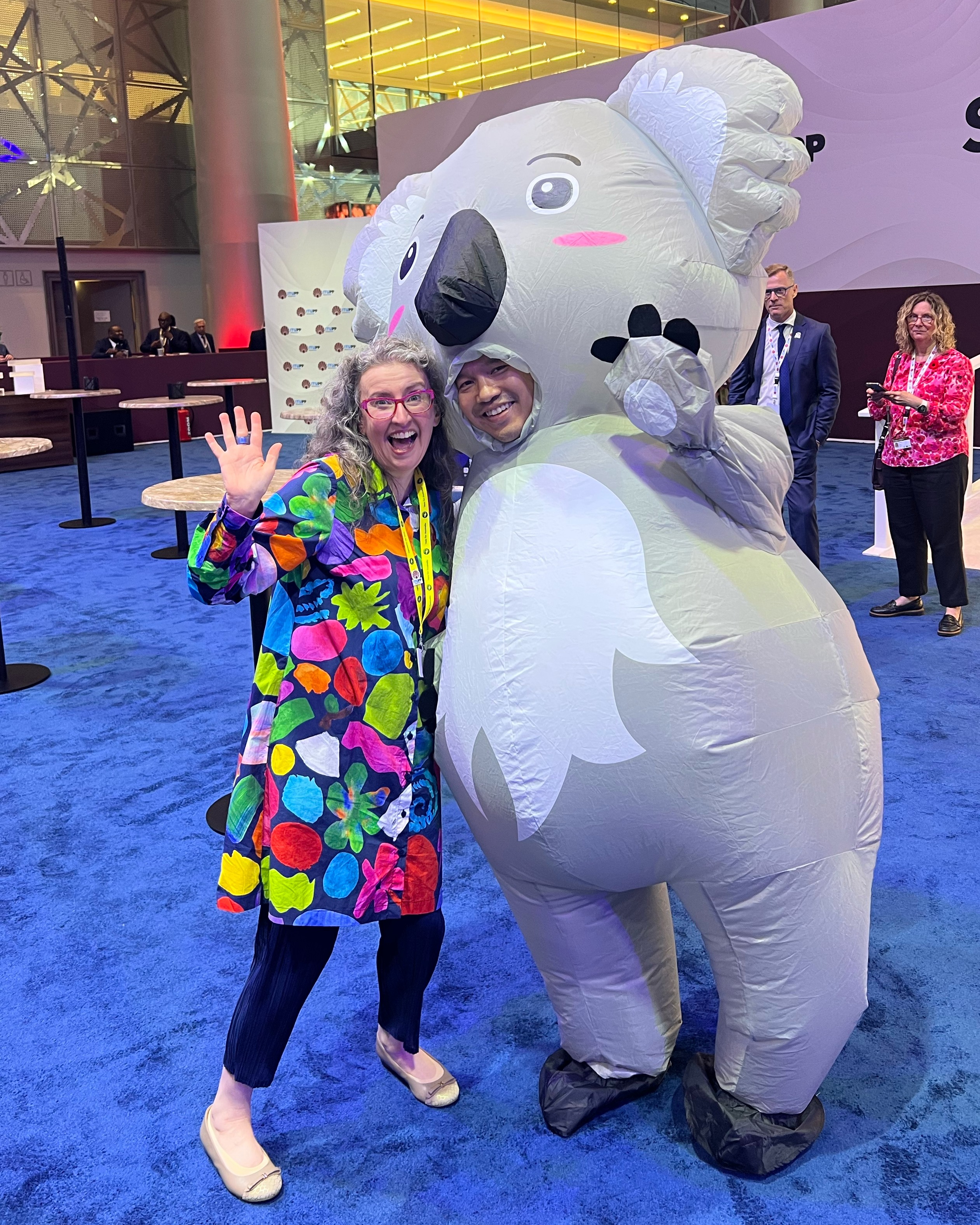
As a member of a government delegation, I have slightly different responsibilities and need to be more careful how I communicate what’s happening onsite in Doha, so I don’t bring the Australian delegation into disrepute, but those who’ve followed me in the past at Plenipots will be pleased to know that Australia is happy for me to still report out to the community and help to bring any expertise out there back into the negotiations here, to help inform Australia’s interventions on the floor.
I also need to thank organizations in the Internet community who have helped support me to be here. I’ll list them for the sake of transparency in a later post, when the funds have come through.
What am I doing while on the Australian delegation?
- Providing advice and expertise on World Summit on the Information Society (WSIS) and Internet related issues to Australia’s leads on these resolutions
I’ve worked in the Internet technical sphere since 2001, attended WSIS Phase II in Tunis in 2005 (where I hid in a cupboard for 5 minutes because I was so over-peopled at one point!), was part of the Australian government delegation to the UNGA WSIS+10 process in 2015, and was an active contributor to Australia’s prep process for the WSIS+20 process in 2025 (and the GDC prep process before that, too).
- Possibly being active on the mic for Australia during ad hoc groups on WSIS and Internet related resolutions.
There are around 400 proposals at this Plenipot, and Australia’s delegation is not huge, so it’s more than possible that Australia’s leads on the WSIS and Internet resolutions will be required to conduct their own “Everything, Everywhere, All at Once” role play, and be in other parallel negotiations here in Doha. Given my long history in the WSIS and Internet spaces, I would then become a backup person on the mic.
- Acting as a conduit between the Australian government and other stakeholders and experts in the Internet/WSIS worlds, to reach out when needed, to ask for more detailed expertise on issues under discussion, and to channel any input that other stakeholders and experts want to send through to Australia.
Over the years, I’ve built up trust not only in the Internet technical community, but also in civil society and the private sector, as well as governments, as someone who’ll listen with an open mind to their concerns and pass it on, without attribution if needed, to others who I think need to hear it. And Australia wants to use those channels to quickly access information on the fly here in Doha.
- Report out to the community about what’s happening here.
I hope to help demystify what can seem like an arcane and what many outside the UN sphere can perceive to be an irrelevant process, but actually has real world consequences.
I’m also here to keep the community informed about the sorts of discussions that are happening, and what issues are turning out to be the most difficult to find consensus on. In part, this is to alert the wider community to where they may be able to contribute positively via their local friendly Member State to help find solutions to those contentious issues. But also, it’s to let stakeholders know what areas governments are most concerned about, in the hope that after this Plenipot, stakeholders can work to find solutions to these issues in the real world, so the various concerns expressed by governments here onsite are resolved via broader multistakeholder processes.
Follow me online
As well as blog posts on this website, I’ll also be active on BlueSky and doing some experimental (for me!) vlogging on YouTube.
To follow Plenipot more widely, the official ITU hashtag for the event across a number of social media platforms is #plenipot