A summary of a very quiet 4th CWG-Internet meeting

Note: I attended the fourth CWG-Internet meeting as a member of the Australian delegation; however, any of the views I express in this blog post are entirely my own. This post does not reflect the official Australian position, nor is its content endorsed in any way by the Australian government.

This is the second part of a two-part report of the fourth CWG-Internet meeting, held 3-4 March 2014. The first part can be found here.

Touré’s opening speech
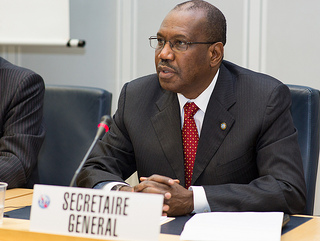
Photo credit: ITU pictures via Flickr

Photo credit: ITU pictures via Flickr

ITU Secretary General Touré was present at the start of the meeting. His presence sent a signal that this was going to be an important meeting, which of course, we found out to not be the case, but it nevertheless sent a message that this CWG was important to the ITU.

Touré stated that the CWG-Internet was a very important component of the multistakeholder dialogue on Internet issues. He also noted that although Brazil’s draft opinion at WTPF-13 hadn’t reached consensus, it had begun a very important dialogue on the role of governments in Internet governance. He also referred to the responses by 37 Member States to the CWG-Internet’s questionnaire on the role of governments, saying not only would they inform discussions at the CWG-Internet, but would form an important repository of information for future dialogue on the issues they contained. He also noted the series of “Open Talks” he had conducted on Internet-related public policy issues.

Importantly, Touré stated that ITU is part of an ecosystem of organizations dealing with Internet-related matters, and that the ITU works to add value where it can.

37 really interesting submissions to the questionnaire on what governments are doing in terms of Internet-related public policy issues

There were 37 responses to the following question:

  • “What actions have been undertaken or to be undertaken by governments in relations to each of the international Internet-related public policy issues identified in Annex 1 to Resolution 1305 (adopted by Council 2009 at the seventh Plenary Meeting)?“

I don’t think there have ever been as many as 37 Member States present at a CWG-Internet meeting, so to have 37 of the 193 ITU Member States submit a response is a major achievement. There were submissions from both developed as well as developing countries, with good geographical diversity, too. A brief overview of the contents of the responses and the discussion in the room during the CWG-Internet meeting:

  • It was encouraging to see some of the Member States compiled their responses by first conducting consultations with various Internet-related stakeholders within their national borders.
  • A number of Member States reported having various forms of stakeholder consultation processes or advisory groups in place where government departments could solicit opinions and feedback on Internet-related public policy issues under consideration. This helped governments create more effective national policy related to the Internet.
  • A number of governments with such consultation processes noted that although the government ultimately made the decisions about national Internet-related public policy, being able to discuss issues with interested stakeholders gave all parties a better understanding of everyone’s positions and the reasons behind decisions, even if non-government stakeholders held views contrary to those that informed the final decisions.
  • More than one Member State referred to the need for governments to develop public policy in coordination with other stakeholders to ensure that innovation on the Net remained unhindered.
  • Member States agreed that the responses should be placed in a permanent online repository where each Member State could update its submission as circumstances changed.

The CWG-Internet decided that the responses to that questionnaire were, like all CWG-Internet documents, limited to Member States only.[1] A large number of States did very much want the responses to be public, saying that the contents would be very useful for everyone. For a little while, there seemed to be agreement to a proposal that all respondents would be contacted and told that their submissions would be made public on a certain date unless they specifically requested their submission be kept password-protected. This agreement fell apart, however, when one Member State suggested that States who might want to keep their submissions password-protected may feel pressured by other States to make them public. States who did not respond to pressure to publish might then be viewed by the wider public as having something to hide.

The good news, though, is that this CWG-Internet meeting decided that the 37 respondents are free to resubmit their contributions as part of the public consultation process that began on 10 March 2014. All contributions to that public consultation are made public.

Oh, and of course, there’s always WCITLeaks, which has already made all of the responses publically available. I was looking at WCITleaks’ links to the responses while the debate was happening in the room and wondered if I should point out to the pro-password crowd that their battle had been lost before the meeting had even begun. But the debate in the room wasn’t about the reality of whether the documents were available or not. It was about a clash of principles: open versus closed intergovernmental proceedings.
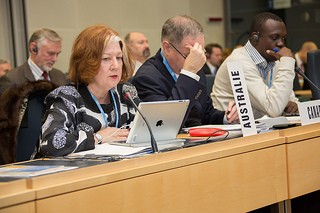
Photo credit: ITU pictures via Flickr

Photo credit: ITU pictures via Flickr

The decision to hold a public consultation

A few Member States had submitted contributions supporting the decision at the third CWG-Internet meeting to hold a public consultation on the role of governments in Internet-related public policy. There had been reluctance back in the third meeting to agree to a public consultation, and States not so keen on a public consultation had successfully introduced an escape clause in the Chair’s report of the third meeting:

  • “The CWG will hold an open multistakeholder consultation on the role of governments immediately after its next meeting in March 2014, based on contributions by Member States.“

While it may not at first be obvious to the casual reader, the “based on the contributions by Member States” text was inserted as a way of allowing the consultation to be quashed if Member States didn’t bother to contribute first (if governments don’t respond on the role of governments, then there would then be no need to hear what non-governments think about the role of governments).

As it happened, with 37 responses by governments, the above argument clearly couldn’t be used to suppress the idea of a public consultation. Instead, creativity was needed. And the arguments of States not wanting to have a public consultation were indeed very creative. One State argued that because many Member States have already stated that they consulted with non-government stakeholders in composing their responses to the questionnaire, the CWG-Internet would learn nothing new by asking non-government stakeholders to submit their responses separately.

A number of Member States were looking forward to holding a public consultation on the same question as that put to governments. But this was another area of contention. Some States argued that it was impossible to use exactly the same question posed to governments as that question was carefully crafted for only governments and nobody else. The strength of this argument was somewhat diminished by the fact that many governments had consulted their non-government stakeholders, and no non-government stakeholders had been harmed as a result of trying to answer this “governments only” question, but anyhow…

Another State argued that there was no way that the same question could be used for non-government stakeholders as there was a risk that non-government stakeholders may contradict the answers governments had submitted as part of the closed governments-only questionnaire. And we can’t have differences in the views expressed by governments and their citizens, can we?

The Member States wanting to ask non-government stakeholders exactly the same question as governments held out for a bit, but eventually capitulated. In the end, to prevent there being discrepancies between what governments have said they’re currently doing in the area of Internet-related public policy and what their citizens say they’re doing, the part of the question about current government activities in the Internet public policy sphere was removed. The final question agreed to was:

  • “What actions are to be undertaken by governments in relations to each of the international Internet-related public policy issues identified in Annex 1 to Resolution 1305 (adopted by Council 2009 at the seventh Plenary Meeting)?“

So, what are the implications of the change of question?

  • It has become a leading question. It suggests that there are things that governments should be doing that they aren’t. It doesn’t give non-government stakeholders a chance to document what governments are already doing. In essence, the question has been successfully reframed by those who believe that governments should have a greater role in Internet governance to produce exactly the sort of result that they want: a set of responses by non-government stakeholders listing areas where governments should be more active. Counterbalancing information, about what governments are already doing, and which may suggest that governments are already doing what’s needed, is excluded.
  • By not including a question about current government activities, there is no way to gather information on government involvement in Internet-related public policy outside the 37 Member States who submitted their responses to the earlier governments-only questionnaire. There are 193 ITU Member States. The CWG-Internet in practice has chosen to actively limit its knowledge about current government practices in Internet public policy to less than 20% of its membership.
  • Given the 37 Member States who responded to the governments-only questionnaire are able to resubmit their responses to this public consultation, we will end up with a collection of divergent responses:
  • One set (from governments) will talk about what they’re doing now as well as what they think should be done in future.
  • A second set (from non-government stakeholders) will only respond to the question about what governments should be doing in future.

How to craft your response to the second CWG-Internet public consultation

The public consultation is open until 26 April 2014.

I suggest that non-government stakeholders making submissions to the public consultation do the following:

  • Note that to contextualize your response to the question about what actions governments should be undertaking in Internet-related issues, it is first important to establish what governments are already doing.
  • Include as many examples as you can about what your national government (or a range of governments, given the public consultation doesn’t limit the question to your own national government) is already doing in relation to Internet-related public policy issues.
  • Include examples of Internet public policy issues where governments are working with other stakeholders. The wider the variety of forms of stakeholder interaction with government are documented, the easier it will be for all stakeholders to learn from the experiences of alternative forms of inter-stakeholder interaction that have not yet been widely documented or publicized. The fact that Member States in the fourth CWG-Internet meeting were asking each other for more details on the forms of multistakeholder interaction they were using is proof that there is genuine interest-even amongst Member States not normally associated with embracing non-government stakeholder interaction-in learning how others develop their Internet-related policy.
  • Encourage stakeholders in the 156 countries who didn’t submit responses to the governments-only questionnaire to submit responses that document current government activities in the Internet governance sphere.
  • Ask your Member State to support your submission at the next CWG-Internet meeting so it doesn’t disappear beneath the waves like the first set of public consultation contributions did at the third CWG-Internet meeting. Your Member State delegate could achieve this by directly referring to your submission in their contribution to the CWG. Alternatively, your Member State could read out the most interesting parts of your submission to the CWG members and provide additional information on the issues discussed in your submission in response to questions by other Member States.

[1] Anyone who followed the 2013 ITU Council debate on the possibility of opening CWG-Internet documents to non-Member States will remember that it was decided that as the creation of the CWG-Internet was a result of a Plenipotentiary resolution, only another Plenipotentiary resolution could make a decision on how open—or otherwise—the CWG should be.

Is CWG-Internet terminally ill or temporarily comatose?

Note: I attended the fourth CWG-Internet meeting as a member of the Australian delegation; however, any of the views I express in this blog post are entirely my own. This post does not reflect the official Australian position, nor is its content endorsed in any way by the Australian government.

Photo credit: ITU pictures via Flickr

Photo credit: ITU pictures via Flickr

The fourth meeting of the ITU Council Working Group on International Internet-related Public Policy Issues (CWG-Internet), held 3-4 March 2014, was a bit of an anticlimax after the very spirited five-day CSTD Working Group on Enhanced Cooperation (WGEC) meeting held the previous week. It seemed that everyone had lost the will to discuss the Internet. Even the Member States keen for a new intergovernmental Internet policy mechanism seemed off their game.

This was the final CWG-Internet meeting before the ITU 2014 Plenipotentiary Conference (PP-14) begins in October. PP-14 will decide the future programs and activities for the Union for the years 2015 to 2018. This includes the future direction of the CWG-Internet. Yet there wasn’t a single contribution to this CWG-Internet meeting proposing how the CWG could or should continue its work after 2014. Of course, the CWG itself can’t decide its work program, but it could have made suggestions on what the group members think is needed and included those suggestions in the CWG-Internet Chair’s report for consideration at the ITU Council meeting in May, and subsequently at PP-14 in October. Instead, the CWG kind of just… floundered…. for its first day, then finished its second day well before noon, having spent the morning finalizing the contents of the 1300 word Chair’s report of the first day.

One of the more colourful Member State representatives—from a Member State that hadn’t submitted any contributions for the meeting—expressed frustration about the lack of progress the CWG seemed to be making. Others also said that there needed to be discussion about the way forward for the CWG. But the fact is that not a single one of these States had taken the time to contribute anything formal to the CWG on possible future directions for the group.

It was all rather odd. Were the frustrated Member States hoping that someone else would do the heavy lifting for them? Was the concerned posturing during the meeting a half-hearted practice run for Internet-related negotiations at the main event, PP-14? Or has CWG-Internet been sidelined by other events and proposals in the Internet governance sphere, including the much-hyped NETmundial in April? Is it simply Internet governance fatigue? Have Member States who’ve been wanting an alternative to the current Internet governance ecosystem, and been forum shopping amongst a growing number of UN bodies, finally reached the same stage of discussion fatigue that those of us who follow the existing Internet ecosystem discussions and the increasing number of UN body discussions have long felt? Are there just far too many big ITU meetings this year and it’s proving difficult to devote time and energy to them all? Frankly, I suspect it’s a bit of all of these things. I guess we have to wait until the next CWG-Internet meeting-if PP-14 resolves to continue the group-to find out whether CWG can wake from its current slumber.

Informal discussions on where the CWG-Internet should go from here

Because there were no formal contributions outlining ways for the CWG to move forward, there couldn’t be any consensus agreements made on the future of the CWG-Internet. But the informal discussions that occurred do perhaps foreshadow more formal proposals for the CWG-Internet’s future activities that may emerge in the lead-up to PP-14. Therefore, I have included a brief summary of those discussions below:

  • One Member State suggested that the CWG-Internet should not duplicate work already being done in other groups.
  • Other Member States suggested that the CWG-Internet should produce more defined outputs (consensus position statements, recommendations, etc.)
  • One of the Member States said that the CWG’s mandate was to focus on international policy (not national Internet policy, which had been the focus of the questionnaire to governments), and the CWG needed to focus on how to address the gaps and weaknesses in international Internet-related public policy so Internet growth could be encouraged.
  • One Member State stated that the CWG-Internet had done its open consultations and it was now time to move on and begin its development phase. The Chair echoed this, stating that open consultation with stakeholders would be an important part of the CWG’s work, but that the group needed to be able to produce structured outcomes from which others can benefit.
  • Another Member State noted that CWG-Internet wasn’t the only group discussing Internet-related public policy issues, but that there is currently no formal relationship that defines how all these groups interact and work on similar or complementary issues. The Member State hadn’t formulated a solution to this lack of clarity but believed something needed to be done if the CWG-Internet was to achieve its objectives.
  • One Member State suggested that the CWG-Internet should beginning looking at the role of governments and the role of other stakeholders in Internet governance. (I should note that I am alarmed by the possibility of a group of governmental folk in a closed environment discussing the roles of non-government stakeholders… and possibly assigning those stakeholders roles in their absence, much like a rerun of the Tunis Agenda definition of stakeholder roles).
  • The Chair wrapped up these discussions by encouraging Member States to submit proposals on the way forward for CWG-Internet to both the ITU 2014 Council and PP-14.

Finally, some musings on the meeting’s participants

There were very few representatives from the Member States that would very much benefit from experience sharing with other States on how to help support Internet development within their borders. In particular, there were only one or two Member States from the African region, and apart from India, none of the developing States from the Asia Pacific region. Latin American and the Caribbean was also poorly represented (Paraguay was present). Instead, the meeting was limited to active participation by Saudi Arabia and Bahrain from the Middle East, Japan, India, Iran and Australia from the Asia Pacific, the USA and Canada from North America and Sweden, UK, Russia, Germany, Poland and Bulgaria from Europe. In other words, the usual suspects, with the usual positions, said the usual things to each other in yet another venue discussing Internet issues.

Is the lack of participation by others a sign of the lack of relevance of the CWG-Internet to their real world needs? Or is the lack of participation a sign of resource constraints preventing developing countries from attending the meeting? ITU does provide fellowships for developing countries, so if non-Geneva based delegates wished to attend, there were some funds available to cover travel costs. This, of course, doesn’t address the issue of limited human resource capacities, and some Member States simply can’t afford to lose a valuable member of their department while they spend a couple of weeks sitting in meetings in Geneva unless they’re certain something of value will come of it. I suspect that lack of relevance played a big part in the lack of participation at this meeting, as the CWG-Internet took place in the same room as earlier CWG meetings, and there were around twice the number of country flags in the room as there were countries represented at the CWG-Internet. Clearly, a lot of the countries felt there wasn’t any need to stay on for the CWG-Internet discussions.

It was also clear that a number of people in the room had very little real understanding of the Internet and ICTs. Many of the same people who attend CWG-Internet meetings are the exact same people who’ve been attending ITU meetings since before the days of the Internet. They’re radio folk, satellite folk, telephone folk, or diplomats from missions in Geneva with a wide portfolio of issues to cover, of which the Internet is just one of many competing for their attention. I understand the need to have experienced diplomats and veterans of the ITU discussing Internet-related issues in intergovernmental spheres, but I also think it would help discussions substantially if those diplomats could bring with them an advisor who understands Internet issues at a level deeper than “I can use the Google”.

My next post, A summary of a very quiet 4th CWG-Internet meeting, reports on the rest of the fourth CWG-Internet meeting, including a summary of ITU Secretary-General Touré’s opening speech, discussion on the 37 contributions to the CWG-Internet questionnaire to governments, and wrangling over the second CWG-Internet public consultation.

Downloadable archive of NETmundial contributions

netmundial logoPost last updated: 13 March 2014

There were 189 contributions to NETmundial.

There have been three sets of duplicate contributions:

  • ICANN Cross Community Working Group on Internet Governance (duplicate  now removed from NETmundial site, leaving only this one)
  • UNESCO comprehensive study on Internet-related issues: draft concept paper proposed by the Secretariat for consultations (duplicate  now removed from NETmundial site, leaving only this one)
  • University of North Carolina – Greensboro (Contributions 144 and 147) Thanks to Adam Peake, who pointed me to this set of duplicates.

Removing the duplicates, the remaining 186 contributions combine to make a total of just over 302,000 words (that doesn’t include the metadata, such as author name, organization and keywords but does include additional attachments that aren’t duplicates of the HTML text). The smallest contribution (Kenya ICT Action Network) contains only 150 words while the largest (The Aspen Institute) is around 39,000 words, including its rather wordy attachment.

Note that many of the documents attached to the HTML contribution pages are simply nicely formatted versions of the HTML pages, but some are completely different texts.

I’ve downloaded all the PDFs of the main contributions and placed them into a single .ZIP file for the convenience of others. I’ve added the contribution numbers as they show on the NETmundial site so the PDFs can easily be cross-referenced with the way they’re listed on NETmundial:

UPDATE: I’ve removed the duplicate entries to reflect the recent removals of two sets of duplicates from the NETmundial site.

Please note that the .ZIP file only contains the main submissions and not additional attachments some people included.

Below is a .ZIP file containing the attachments not included in the above file. I have not included the attachments that were the nicely formatted versions of the PDF texts included in the original .ZIP file above. If you want those, you’ll have to click through to them from the PDFs in the above .ZIP file. The attachments in the .ZIP file below contain completely new material not in the above .ZIP file or versions of the same PDFs, but with diagrams and tables included.

The filename convention I’ve used for the attachments is :

<contribution no. as given on NETmundial index pages> – attachment <no. if more than 1 attachment> – <description of attachment>

For my own analysis, I’m putting together a spreadsheet that will identify which stakeholder group and geographic region the submissions come from. I’ll post that to this site, too, if I get it finished before the NETmundial folk do something similar.

UPDATE: NETmundial has posted a pie chart and graph from their Twitter account showing contribution statistics, but there is nothing on the main website yet. I’m sure this will come shortly.

Multistakeholder processes are messy

Thoughts from the WSIS+10 preparatory process

I remotely followed, on and off, the third WSIS+10 High-Level Event Multistakeholder Preparatory Platform (MPP) meeting that was held in Geneva this week. In contrast to the outcome documents of First and Second WSIS Phases in 2003 and 2005, which were devised in a purely intergovernmental environment,[1] the texts of the WSIS+10 High Level Event are being developed by all stakeholder groups. And it is extremely painful.

Many of those onsite have been very frustrated at the incredibly slow pace of progress being made. Progress has been so slow, it has seemed that entire species might evolve and die out before consensus can be reached on the texts.

Some might blame the political manoeuvring of government representatives at the meeting. And, indeed, there has been some truly twisty logic in some of the interventions by some of the more colourful government delegates in the last day or so. But other stakeholder groups have also been adding to the complexity and confusion too.[2]

The progress made on the text for the High Level Event has been so slow that yet another physical preparatory meeting has been added to the calendar.  With the WSIS+10 High Level Event now tentatively pencilled in for June 2014, there really isn’t any time left to squeeze in a sixth preparatory meeting if agreement continues to be hard to achieve. At the end of yesterday, entire action lines had been placed in square brackets (denoting the text hasn’t been agreed). The possible outcomes from the process are two texts that are, in the true spirit of intergovernmental consensus-based drafting traditions, bland, vague and pretty much not useful in the real world. Alternatively, given the trend during the third MPP to remove the word “multistakeholder” in the draft texts, the resulting texts could end up emphasizing government roles in the Information Society at the expense of the other stakeholder groups’ roles in the Information Society.

So has ITU’s commitment to a multistakeholder development of a WSIS+10 vision been misplaced? Are the MPPs proving that multistakeholderism is not effective? Should ITU go back to purely intergovernmental negotiations?

The answer to all three questions is “No”.

Messiness isn’t automatically a bad thing

Multistakeholderism is messy for the exact same reason that it’s effective. The messiness is a side effect of incorporating the cacophony of positions and knowledge that ultimately can lead to a robust, multifaceted understanding of an issue.

Wicked problems, including those in the Internet governance sphere, don’t have simple solutions. They aren’t ultimately solvable. All that can be done, in reality, is to find the best of the non-solutions out there. And the best way to do that is to look at the problem from all possible angles and to examine all possible ramifications of trying to do something, or not so something, about it.

Multistakeholderism is a great way of achieving this. Where intergovernmental deliberations can get stuck in ideological trenches dug deeper and deeper over long-term inter-state rivalries, multistakeholder deliberations bring a range of parties to the table who not only bring new knowledge and understandings to the discussion, but, as parties who aren’t always wedded to their own government’s positions on issues, can help find alternative, middle ways between rival government positions.

Multistakeholderism has always been messy. It was perhaps less messy in earlier Internet governance days when fewer people were participating. But over time, as more people are becoming involved, the range of positions and breadth of information brought to the discussions is expanding, making the messiness more apparent. Also contributing to this messiness is the fact that not all of the mechanisms we have used since the 1990s to manage multistakeholder Internet governance process are scaling that well. We are seeing efforts to address this through the Panel on Global Internet Cooperation and Governance Mechanisms as well as the NETmundial meeting in Brazil in a couple of months.

Messiness is here to stay

The reality is, though, that the messiness is likely to be a permanent feature of multistakeholderism. But we shouldn’t fear it. And the last thing we should do is walk away from existing multistakeholder processes in the naïve belief that creating new processes and forums will avoid the problems of the past. As we’ve seen from the mushrooming of Internet governance processes in the last couple of years, new processes can experience significant teething problems (for example, 1net) and can fall victim to the same problems as older forums as more people join in (for example, civil society’s Best Bits list has exhibited signs of the same problems the older Internet Governance Caucus list has experienced). In addition, new venues and processes add to an already crowded Internet governance calendar and can make it more difficult for less well-resourced stakeholders to participate in multiple venues.

Working more effectively in a messy multistakeholder world

We can learn to work with the messiness, though. To do that, we need to learn to be more flexible, more open to accept the views of others and, above all, to have a healthy sense of humour when the messiness threatens to overwhelm us. We also need to remember that people participate with the aim of making things better. What one person thinks is “better” may, to another person, be “worse”, but if we only view another person’s ideas as a threat that must be disarmed, we are personally contributing to the failure of the multistakeholder process.

Doing the above can be really hard to do at the end of a long few days of being stuck in a room together, but without at least beginning the meeting with these goals in mind, the end of the meeting is guaranteed to end on a sour note (WCIT, anyone?).

Also vital to keeping a messy multistakeholder process as pain-free as possible is ensuring that people do their homework before going to meetings where decisions are being made. The need for this has been demonstrated at the latest MPP meeting. Participants who hadn’t done their preparation lost the goodwill of other participants who had prepared and were ready to move to the next phase of text development.

It’s very easy to criticize others for making a multistakeholder process painful. It’s less easy to take ownership of our own contributions to the messiness of multistakeholderism. But I think we’re getting there.

In the wake of the bad feelings produced by the WCIT process, stakeholders have been more willing to find ways to work better with “the opposition”, and have been more willing to listen to the arguments of others. I don’t think the frustrations of wildly different opinions will ever be able to disappear completely, but we can at least learn to recognize that wildly varying opinions are just as legitimate as our own. For example, while it’s easy to be frustrated at the handful of governments worked to remove references to “multistakeholder”, and even “freedom of expression”, from the WSIS+10 High Level Event texts this week, we need to understand that these positions arise from specific political, social and economic contexts that differ from those of the participants who actively supported keeping “multistakeholder” and “freedom of expression” in the texts. We may not agree with their points of view, but that doesn’t mean we should dismiss such views out of hand. Instead, we should recognize the context, and understand that some views on Internet governance issues will continue to differ as long as people’s political, social and economic situations also remain divergent.

We all have something we can learn from the processes of stakeholder groups other than our own. Business, civil society and the technical community have been very keen to help governments understand what’s good about multistakeholder Internet governance processes outside the purely intergovernmental system. But it’s also time that non-government stakeholders stopped viewing governmental processes as automatically “evil”.

One important lesson we can learn from the intergovernmental world is politeness. All that “I thank my esteemed colleague from X” preamble that happens before country Y demolishes X’s proposal has a point. It softens the pain of the objection. Contrast this to the worlds of the technical community and civil society where name-calling and insults have made semi-regular appearances.[3] While, particularly in the technical community, the upfront nature of such clashes are often seen to be signs of how dynamic, frank and “honest” the discussions are, they can leave a residual bad feeling that affects future interactions.

Multistakeholderism and the WSIS+10 High Level Event

The recent MPP is an example of a wider clash between participants who are coming to the multistakeholder discussions in a genuine and open manner and others who would prefer to have the WSIS+10 vision developed in more traditional intergovernmental ways. There is a danger that the latter will try and use the messiness of the previous MPP meetings to justify why multistakeholderism is a failure and that there needs to be a return to more orderly governments-only negotiations. It’s easy to be angry with those who may be attempting to achieve this goal. But being combative in response is not going to help. Instead, it’s important to embody the best of multistakeholder cooperation, and show how the messiness can and does lead to more robust and responsive outcomes that meet a wider range of stakeholders’ needs.

It’s important that non-government stakeholders continue to engage in the MPP meetings and show that there is support for multistakeholder processes, even when those processes are difficult to navigate.

The alternative to continuing to participate in the WSIS+10 MPP meetings is letting the WSIS+10 process revert to the traditional intergovernmental model. As we’ve seen with the Tunis Agenda, which was developed via that intergovernmental model, the text has become the canonical reference for discussions relating to the development of a global Information Society for almost a decade. The texts that emerge out of the WSIS+10 will probably have the same sort of presence for the coming decade. Non-government stakeholders have over the years, pointed out a number of times that the Tunis Agenda has limited legitimacy due to its governments-only composition. It’s now up to those same non-government stakeholders to stick with the messy MPP process to ensure that the WSIS+10 documents reflect a more comprehensive view of what Information Society should look like in the 2020s.


[1] There were non-government participants on some of the government delegations but the negotiation was fundamentally intergovernmental in nature.

[2] For example, a civil society participant declared that data privacy was not needed in the context of eHealth as any data being exchanged was for the benefit of people.

[3] Tomato throwing was seriously discussed by some members of the technical community a few years back when Verisign launched Site Finder.