WTPF-13 Opinions 5 and 6

The first day of the World Telecommunications/ICT Forum (WTPF-13) went so well. Day two started off well, too. Then we hit Working Group 3.


Credit: ITU

Multistakeholderism and enhanced cooperation

Working Group 3 was tasked with discussing Opinion 5 and Opinion 6 on multistakeholderism and enhanced cooperation.

Traditionally, these two concepts have generally been seen as polar opposites. Multistakeholderism represented the current Internet governance ecosystem that has evolved organically since the Internet’s creation. Enhanced cooperation represented the desire of some governments to have more say in how the Internet operates.

Multistakeholderism has been associated with openness and freedom of expression and innovation at the edges. Enhanced cooperation has been associated with a more locked down model of the Internet: one where fears of cybercrime and spreading dissent amongst citizens are some of the driving forces.

It is interesting, therefore, that the Informal Experts Group (IEG) had reached consensus on two draft Opinions that endorse, separately, multistakeholderism and enhanced cooperation. But could this consensus survive Working Group 3 onsite in Geneva? The short answer is “yes”. Some of the reasons I think that this happened are described below:

Why Opinions 5 and 6 survived Working Group 3 almost unchanged

1. IEG consensus versions were innocuous
The IEG consensus texts on multistakeholderism and enhanced cooperation were pretty bland when compared to other, more polarizing, texts and proposals on the same issues.Some earlier versions of the enhanced cooperation draft Opinions had been more alarmist in tone. For example, this was included in a draft at one point:

[…]that, despite its essential character, the Internet continues to suffer from critical weaknesses in its security protocols and in its governance processes that also make it the vehicle for spam, online child pornography and other abuses of children, identity theft and many other forms of cybercrime, damaging denial of service attacks, and disregard of considerations of national security, public order, public health and public morals while enjoying freedom of expression

The IEG consensus text, however, had been shaped into something all could find acceptable.

The UN General Assembly’s instructions late last year to CSTD that it create a Working Group on Enhancing Cooperation (WGEC) certainly helped take the heat out of the Opinion 6 debates. After all, it was pretty clear to everyone that it wouldn’t be appropriate for ITU Member States to be making decisions about a topic that the UN General Assembly has given to the CSTD to work on.

I’m sure that while everyone wished the drafts expressed more of their own views on the topics, everyone was also happy that the views of others didn’t dominate the Opinions.

2. Precedent
The second reason the Opinions survived without much change is the precedent set by the first four Opinions discussed at WTPF-13. In each of those cases, there had been many statements, often from those who participated in the IEG, that the consensus text reached in the IEG meetings should be respected. They should be respected because they had incorporated the widest range of opinions that could reach some level of agreement amongst all stakeholders.Even the smallest proposed changes had met with considerable opposition in Working Groups 1 and 2. In the end, there was only a single word change made during the discussion of the first four Opinions. That change was the inclusion of “relevant”, in relation to “international, regional and national forums” in the broadband-related Opinion 2. None of the other proposed changes were accepted. Instead, proposal authors dropped further pursuit of their proposals after:

  • Being convinced by discussions on the floor that the goal of the proposals was already covered in the existing draft Opinion text, or
  • Agreeing to the Working Group Chair ‘s suggestion that their concerns be included in the Chair’s Report of the Working Group’s activities.

It was very easy, therefore, for Working Group 3 to follow the same pattern as the earlier two Working Groups.

I suspect that, aware of the order of discussion of the six Opinions, some States worked hard to prevent significant redrafting of the earlier draft Opinions precisely so this precedent would be in place by the time the most difficult of the draft Opinions, 5 and 6, were up for discussion.

3. Concern by States that they could lose ground in the negotiation process
As I mentioned in point 1 above, the text of draft Opinions 5 and 6 were the result of intense negotiations within the IEG. While, no doubt, nobody was entirely happy with the text that came out of the last IEG meeting, everyone could be reasonably satisfied that the text, at the very least, didn’t contain anything that could seriously damage their chances of achieving their long-term Internet governance goals.

Given the short time available for discussion onsite in Geneva, many delegates were probably aware that there was a chance of something damaging to their position slipping into the text before they had the chance to understand its full ramifications. “Better the devil you know,” basically.

4. Lack of any strong leader pushing for stronger texts
If WTPF-13 had been held before the death of Syria’s Nabil Kisrawi in early 2011, I suspect it might have had a very different outcome. Kisrawi was the leading force amongst ITU Member States. He knew ITU procedures back to front. He passionately fought for the issues he thought should be fought for. Since his death, however, there hasn’t been anyone to replace the Kisrawi-shaped hole in the ITU world.Kavouss Arasteh from Iran has tried, but hasn’t quite succeeded in replicating Kisrawi’s forceful presence in ITU meetings. In fact, at WTPF-13, Mr Arasteh has changed his earlier focus from one that focuses solely on ITU’s role in Internet-related issues to one that sees collaboration and cooperation between ITU and Internet organizations as the way of the future. (His first ICANN GAC meeting in Beijing last month was apparently his “Saul on the road to Damascus” moment).

With nobody rallying the troops to call for changes to the IEG consensus text, States who had submitted proposed changes were left arguing for the changes on their own, with few or no other States to back them up.

5. Brazil’s separate draft Opinion
Brazil submitted a separate draft Opinion, Operationalizing the Role of Government in the Multistakeholder Framework for Internet Governance. Its content were somewhere in between the content of Opinion 5 and Opinion 6, encouraging greater government participation in Internet governance, while not proposing a governments-only form of enhanced cooperation. It had the potential to keep both pro-multistakeholder and pro-enhanced cooperation parties happy.Russia had originally submitted substantial proposed changes to Opinion 5. If those proposed changed had been discussed as part of Opinion 5, I suspect we still wouldn’t have an agreed version of the text. But the appearance of Brazil’s separate draft Opinion saved the day. Russia agreed to a request by the Chair of Working Group 3 to discuss Russia’s proposed text as part of Brazil’s proposed draft Opinion.

Where we’re at right now

Opinions 5 and 6 will go to Plenary for final approval this afternoon. The issues related to government participation in Internet governance processes, raised by Brazil’s draft, are still unresolved after a full morning of discussion.

Brazil’s revised draft Opinion didn’t reach anywhere near consensus during the discussions, although there was broad agreement that the issues were important. Instead, a summary of the discussion will be included in the Report of Working Group 3 Chair. The Chair has suggested that a summary on where Brazil’s draft stands, including the feedback of the WG3 participants, be sent to the ITU Council Working Group on international Internet-related public policy issues (CWG-Internet). CWG-Internet may then forward it to the ITU Council, which in turn may decide how to proceed with it within the ITU framework.

I will blog separately, and later, on the discussions of this morning’s WTPF-13 session. Stay tuned!

The first day and a half of WTPF-13

Day 1 was the day of blue peacekeeper’s helmet. Day 2, though, is turning out to be the day of rolling up the sleeves as delegates dive into discussions on the Opinions about multi-stakeholderism and enhanced cooperation.

For those who weren’t there, below is a brief summary of the first day and a half of the World Telecommunication/ICT Policy Forum 2013 (WTPF-13).


Photo credit: Veni Markovski

Day 1: The blue helmet of friendship

Whether it was a demonstration of the ITU Secretary-General’s own media savvy, or the result of an ITU media staff brainstorming session, the image of Secretary General Toure donning a peacekeeper’s pastel blue hard hat is sure to be the defining moment of the Forum. Why the blue helment? To reinforce his sincerity when making the following announcement:

During the conference itself, there was a great deal of concern that ITU and the United Nations was trying to take control of the Internet. Let me announce you today it is my pleasure to announce today —

[Applause.]

— that we are not taking over the Internet.

[Laughter]

The UN peacekeepers and their blue helmets are not coming to take over the world’s ISPs. The UN peacekeepers are not coming to take over the root servers and the DNS. And my good friend [Fadi Chehade] can continue to do the good work he’s doing at ICANN.

Given the very bitter taste left in a lot of people’s mouths after WCIT-12 last December, Toure’s light-hearted approach to bridge building was probably the right way to go.

Day 1: Two hours of participants talking longer than their allotted three-minute slots

This is the sort of thing the Internet Governance Forum (IGF) deliberately avoids. For a newcomer, two hours of ITU Members giving prepared speeches that are (sometimes rather tangentially related) responses to the Secretary General’s WTPF report can seem like a mind-numbing exercise. But it is actually very valuable . It’s a preview of what all the players will be fighting for during the week. For example:

  • USA, Canada, the UK and others made it clear they didn’t want the text of the draft Opinions to be reopened for drafting during the Forum
  • Singapore stated its that WCIT Resolution 3 had no adverse effect on the multistakeholder nature of the Internet, subtly suggesting that it didn’t appreciate many States not signing the ITRs at WCIT-12
  • Saudi Arabia noted its concern about the potentially adverse impact of the legacy IPv4 market, signposting its particular interest in the contents of the two draft Opinions under discussion in Working Group 2
  • A number of State representatives simply thanked the Secretary General and the Informal Experts Group for developing the WTPF report and proceeded to give an overview of recent ICT achievements in their countries. Such speeches can be interpreted as a sign that these States have no particular views on the topics of the Opinions and won’t be active participants during the discussions on the draft Opinions. It also lets the more active States know which States might be open to being convinced to support their opinions on issues.

Copies of the speeches submitted to the ITU Secretariat are available from WTPF-13: Speakers and Statements. Note, however, that the official submissions and what was said on the floor aren’t always a match. Some speakers went off script, preferring to wing it in the heat of the moment.

Day 1: A very speedy Working Group 1

Working Group 1 discussed the first two draft Opinions:

  • Draft Opinion 1: Promoting Internet Exchange Points (IXPs) as a long term solution to advance connectivity
  • Draft Opinion 2: Fostering an enabling environment for the greater growth and development of broadband connectivity

These were the two least controversial Opinions of the Forum, so it’s no surprise that both reached consensus within an hour. The majority of comments made in the room were to express a preference for no changes to the existing text of the draft Opinions. The reasoning given for this preference was that the Informal Experts Group (IEG), which was multistakeholder in composition, had already worked hard to develop consensus on the draft Opinions and that no positive outcome could be achieved by trying to renegotiate a new consensus in the short time available during WTPF-13 in Geneva.

There was a slightly surreal discussion whether it was necessary to exclude stakeholder participation in irrelevant forums by specifically adding mention of their attendance at relevant forums. This was prompted by Turkey’s proposal to include the word “relevant” in Opinion 2:

Invites member states, Sector Members and all interested stakeholders

To continue to work, as appropriate, in the activities of ITU, and in all relevant international, regional and national forums considering[…]

Iran started the discussion:

IRAN: […] I think this modification is consistent with the text. Usually sector member, state member, stakeholder, all of them, they participate in relevant meetings. They do not participate in irrelevant meetings.

Sweden hopped on board:

Sweden: […] We have listened with interest to the interventions. And we also heard statements that administrations, sector members and all stakeholders participate in the relevant meetings; they don’t participate in irrelevant meetings. And taking that into account, we believe that it’s not necessary to add the word “relevant” to this draft opinion.

Turkey reaffirmed their commitment to including “relevant”, though, and in the absence of any strong objections to including a word that didn’t materially change the meaning of the Opinion, the word was added to the final version of the Opinion.

Day 2: An even speedier Working Group 2

Working Group 2 discussed:

There is a long and contentious history of discussions on the ITU’s role in IP addressing issues. It was with great surprise, therefore, that it took less than 30 minutes for the Working Group to adopt both the text of both Opinions unchanged. Once again, the main reason delegates used to support the existing draft Opinion texts was a belief that the consensus developed by the IEG should be respected.

Then we hit the speed bump otherwise known as Working Group 3.

Day 2: Ongoing Working Group 3 discussions

This was always going to be the liveliest Working Group. Its task is to discuss:

  • Draft Opinion 5: Supporting Multi-stakeholderism in Internet Governance
  • Draft Opinion 6: On supporting operationalizing the Enhanced Cooperation Process

The Chair chose to begin the Working Group’s discussions with Opinion 6, on enhanced cooperation. After the first two hours of discussion, the Working Group broke for lunch, with no resolution on the Opinion.

Like it or not, enhanced cooperation is the hottest topic in the Internet governance world right now. It almost derailed the work of the CSTD Working Group on IGF Improvements in 2011. It almost derailed the drafting of the Draft resolution on Assessment of the progress made in the implementation of and follow-up to the outcomes of the World Summit on the Information Society during the 15th CSTD session in May last year. Composition of the new CSTD Working Group on Enhanced Cooperation has also proved contentious.

Fundamentally, at issue in Working Group 3 are proposals to:

  • Include additional references to specific paragraphs in the Tunis Agenda
  • Include a more specific “invites” paragraph
  • Add a reference to “the future” in the “is of the view” paragraph

A number of delegates, as in Working Groups 1 and 2, object to any text changes on the basis that the IEG consensus text should be respected. There have been a number of statements from States supporting the IEG consensus text that the reasons behind the various proposed changes are already addressed in the existing text. There have been suggestions that to open up discussion on the draft Opinion would not lead to any consensus on a new version in the short time available during the Geneva meeting. The authors of the proposals, however, were very much concerned that the reasons behinds their proposed changes still needed to be addressed.

The “go with the IEG text” reasoning, however, seemed to be winning over the room for a while this morning. Then Chile stepped in. It stated that was not possible for some States to attend the IEG meetings and participate in the development of the draft Opinions. If the IEG consensus texts were adopted as the final Opinions, it was effectively barring the input of those States who had come to Geneva to participate in the drafting, but hadn’t been able to attend the IEG meetings. Other countries, including Mexico and Argentina, also supported this view.

The Chair pointed out that remote participation had been possible, even if physical attendance had been out of the question for some members. Haiti asked why WTPF was being held if all the decisions about the text of the Opinions had been decided in the IEG meetings. Bahrain suggested that WG3 would be a good place to enable discussion on the views of those who hadn’t attended IEG meetings. India then suggested going through the text of Opinion 6, paragraph by paragraph, amendment by amendment, on screen. At this point, we were heading into the lunch break.

The current state of play is that anyone who spoke on the floor this morning has been asked to send their proposals to the Working Group Chair. An informal meeting during the lunch hour was meant to thrash out how to proceed with the proposed changes to Opinion 6.

The afternoon session is about to begin any moment now…


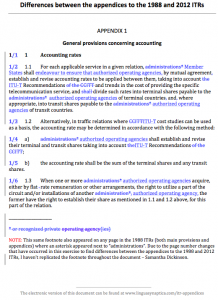
Tracking the changes between 1988 and 2012 ITRs

WCIT-12 may have ended, but now begins the work of analysing how the ITR changes will have an effect on international telecommunications.

To help those wishing to do that analysis, below is a PDF that shows exactly what has changed, in the English versions, between the 1988 text and 2012 text of the International Telecommunication Regulations. Article 7, Suspension of services, is the least-changed of all the provisions in the ITRs. All other provisions have a significant number of text changes.

17 December 2012 update: In tidying up the slightly weird way Word had performed the “compare documents” function, I inadvertently included some text twice in deleted item 45, section 6.1.3. The PDF linked below contains the updated, amended version.

ITR differencesDifferences between 1988 and 2012 ITRs